A Captured Comet Torus as a Possible Younger Dryas Forcing
In plain language
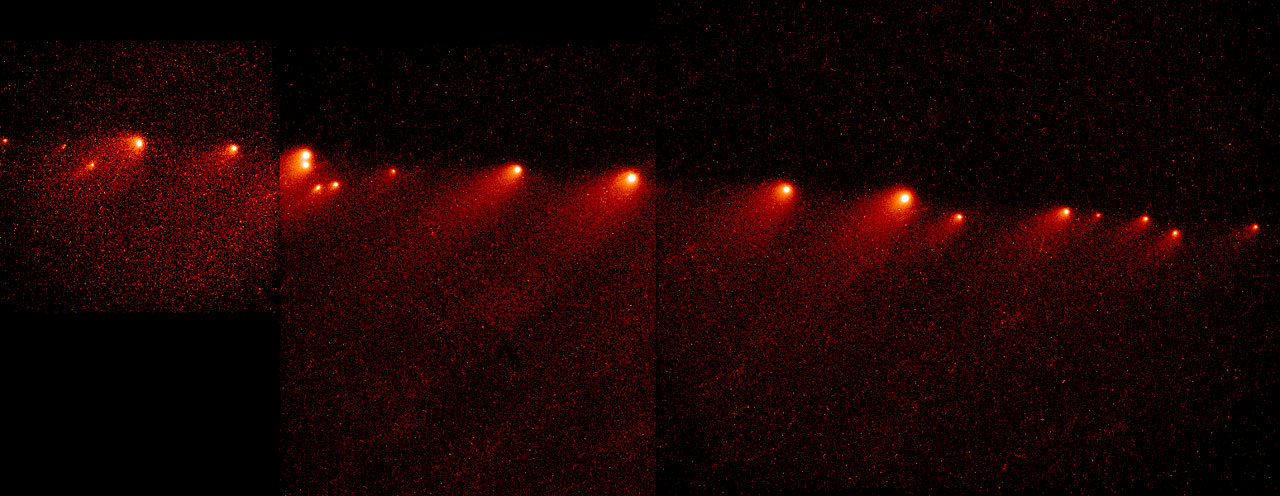
In 1993–1994, astronomers watched Jupiter hold a comet, tear it into a “string of pearls,” and then absorb the fragments. This draft asks whether something like that could happen at Earth, and what it would mean if it did.
The suggested picture is this: Earth sometimes captures a small body for a time. The Moon would disturb anything orbiting between it and Earth. A loosely bound icy body might be driven inside Earth’s Roche limit and break up. The fragments of an ice-rich body 17 to under 30 km across could, the draft argues, supply a thin torus of ice and dust for about a thousand years, cutting sunlight by a few watts per square meter — comparable to estimates for Younger Dryas cooling.
The author is plain about the weak point: capture of a body this large is not demonstrated, and the draft’s own tests of several capture routes came out negative at typical comet speeds. The idea is offered as a possibility worth more study, together with a test.
Abstract
The abstract is taken from Draft E, 17 October 2026:
Thirty-two years ago, astronomers watched Jupiter capture a comet, tear it into a string of fragments, and absorb the pieces. Earth is smaller, but the same physics applies. Lines of evenly spaced craters on the Moon suggest that bodies broken up by Earth's tides have struck the Moon.
This paper builds a chain of established observations toward a suggested scenario: Earth sometimes captures small bodies temporarily. The Moon strongly disturbs anything orbiting between it and Earth. A loosely bound icy body would more often than not be driven inside Earth's Roche limit within years and break up. The fragments of an ice-rich body 17 to under 30 km across could supply a thin torus of ice and dust for about a thousand years. It would cut sunlight by a few W/m², comparable to or larger than the forcing usually estimated for Younger Dryas (YD) cooling.
The weakest link is the capture of a body this large. We do not know how it would happen, and our own tests of several capture routes came out negative at typical comet speeds. We therefore offer the scenario as a reasonable possibility that deserves more study, together with a test. A long-lived orbiting source would leave a continuous extraterrestrial signal (osmium isotopes, iridium, nickel) through the whole YD interval in ice cores.
What this draft does not claim
- It does not claim that Earth is known to have captured a body of this size.
- It does not claim that a comet torus has been shown to be the cause of the Younger Dryas.
- It records that the author’s own tests of several capture routes were negative at typical comet speeds, and treats that as the weakest link.
How to test it
From the draft: a long-lived orbiting source would leave a continuous extraterrestrial signal — osmium isotopes, iridium, and nickel — through the whole Younger Dryas interval in ice cores.
Found an error in this summary? See Contact.